Mesh Things is our open-source platform for collecting, storing and processing sensor data from LoRa Mesh networks such as Meshtastic. It ingests the encrypted radio traffic of a mesh and converts it into clean, stored readings, along with alarms, quality checks and a REST API. Mesh Things can run on a cloud server or on a Raspberry Pi. It is live at things.sensical.es.
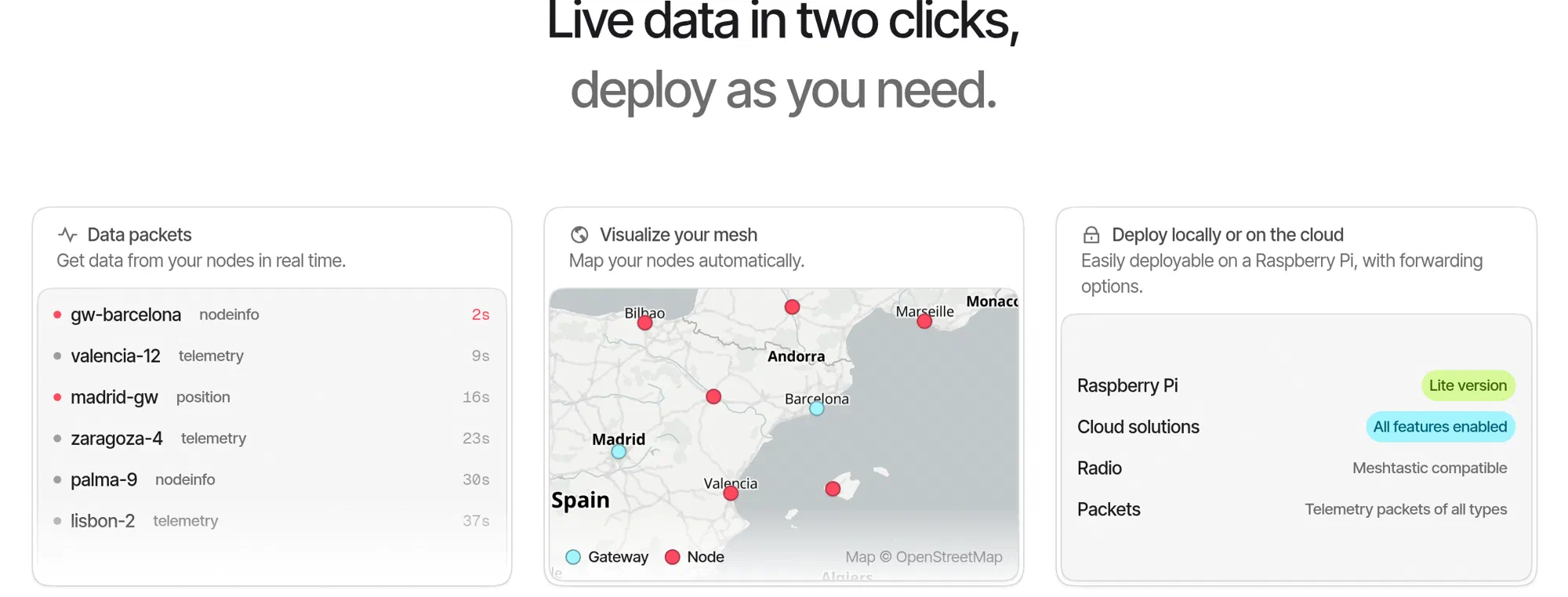
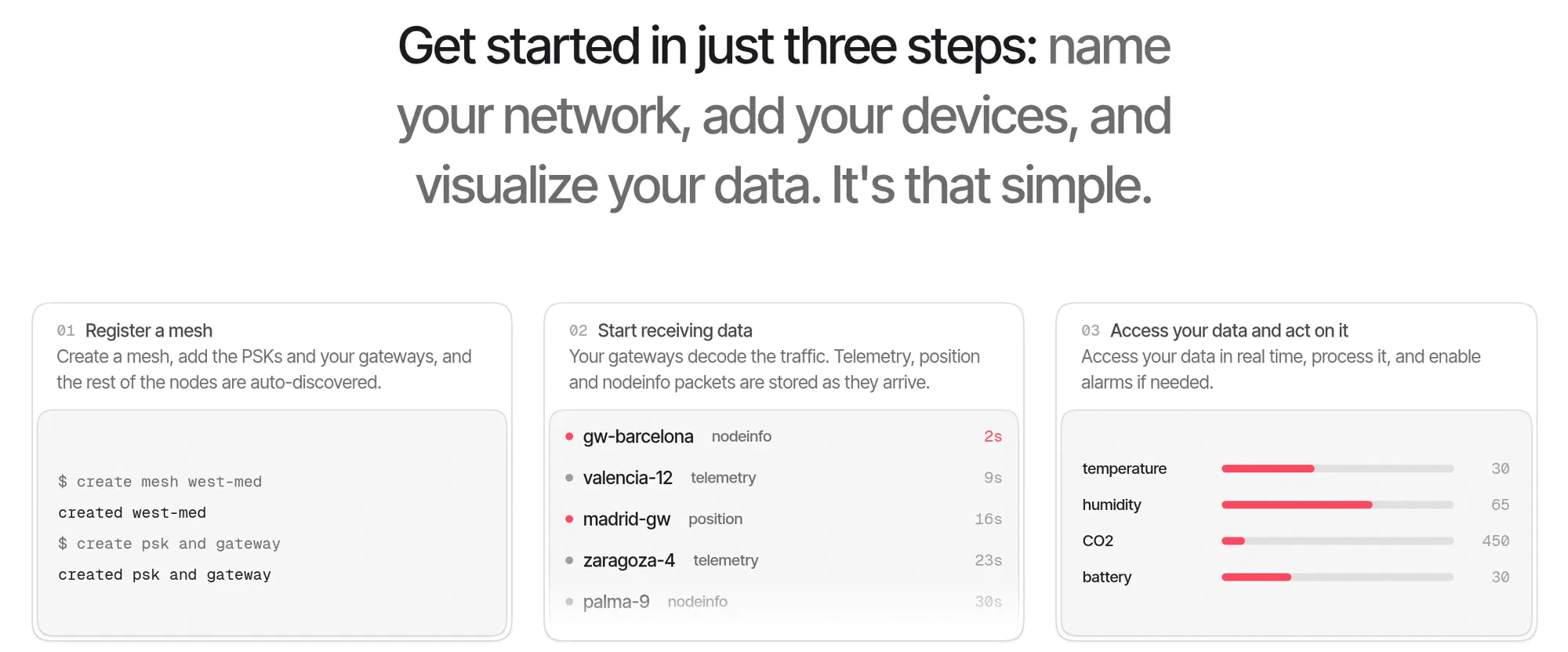
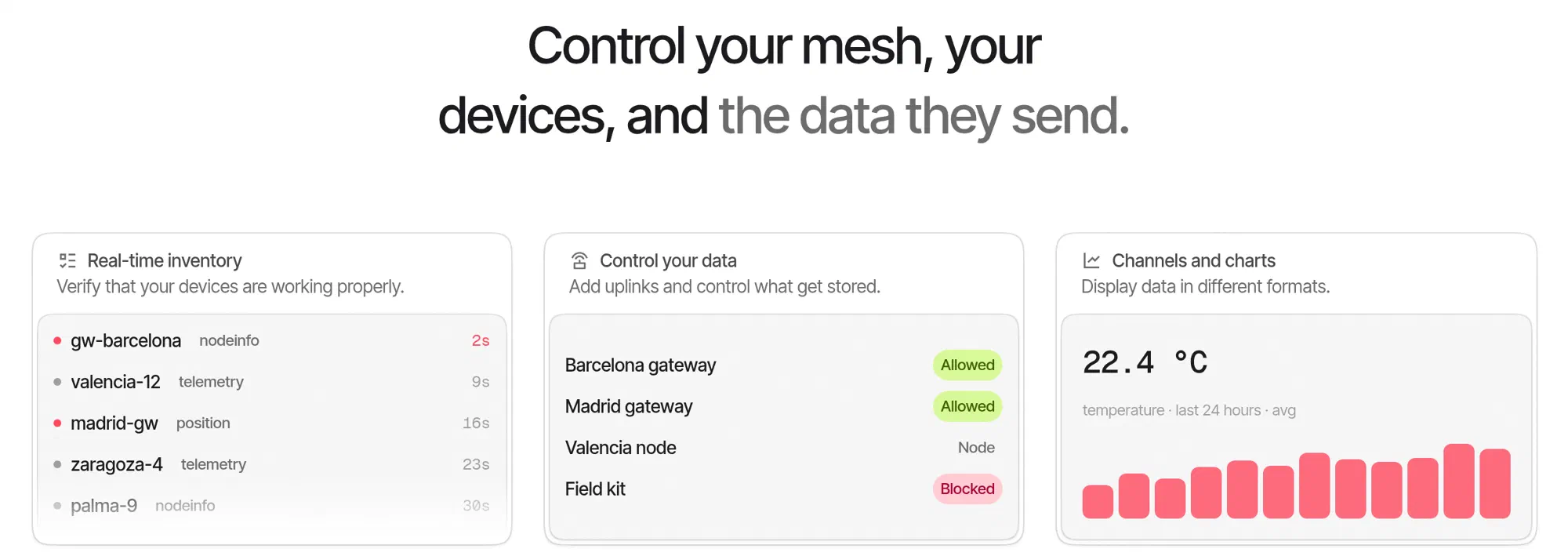
A Meshtastic mesh: nodes relay each other’s packets until a gateway sends them to MQTT.Live packets, a map of the mesh, and deployment on a Raspberry Pi or in the cloud.Getting started: register the mesh, receive data, act on it.Device inventory, control over which gateways publish, and charts.
01 / 04
The challenge
Meshtastic has made long-range, off-grid LoRa mesh networks cheap and easy to set up, and it is a natural fit for environmental sensors in places without power or coverage. However, getting the data out, and making use of it, is harder: gateways publish the mesh’s packets to MQTT encrypted and in Meshtastic’s own protobuf format, the same packet often arrives several times through different gateways, and the established IoT platforms do not support Meshtastic natively. Mesh Things is a unified solution that helps teams build LoRa mesh data collection networks without building and maintaining their own decoding layer.
Mesh Things
Mesh Things allows you to:
Register meshes and devices, decrypt and decode their packets with the channel key. Auto-discovery allows gateways and the nodes behind them to be automatically stored from the traffic itself.
Store every reading in a time-series database, with an optional Parquet archive on S3-compatible storage for long-term analytics.
Process data on-the-fly: sensor calibration and derived channels, data-quality checks and pattern detection are performed as data arrives.
Raise alarms on thresholds, flat or missing readings and gaps, with notifications by email and more.
Connect to other systems: import meshes from remote MQTT brokers, and share decoded readings with third parties over MQTT, so they can flow into the platform you already use.
A console and an API: use our console with our live device inventory, featuring mesh maps and traffic analytics. Build charts, choose which gateways and nodes are stored, and manage alarms and data processing blueprints. Access data through a REST API, S3 storage and DuckDB, with a Python package to access the data natively.
Flexible deployment options
Mesh Things runs with Docker Compose in two sizes:
a lite version ingests, decodes and stores data, and is small enough for a single-board computer such as a Raspberry Pi in the field.
a full version adds stream processing, quality checks, MQTT sharing and the archive, built on established technologies such as Kafka, Flink, EMQX, InfluxDB, PostgreSQL and Redis.
Open source
The platform and its web apps are published on GitHub, and the documentation is at things.sensical.es/docs:
mesh-things: ingestion, decoding, processing, storage and API (GPL-3.0)
To use Mesh Things for your sensors or your network, write to us at info@sensical.es.
Services involved
Environmental sensor integration
Sensors
Integration
Mesh networks
We integrate environmental sensors into flexible, affordable, and reliable data systems: from the sensor and its firmware, through the network that carries its data, to the platform where that data is stored, visualised and used.
We are proud contributors to the Meshtastic firmware, the open-source firmware that turns affordable LoRa radios into off-grid mesh networks, bringing field-tested solutions to the open-source ecosystem.